

I’ve been a bit out of it due to the tremendous amount of work in getting a new (very old) home up to speed – no electricity and initial water issues… but we’re starting to make headway. Today I had a successful day….
Clarification: None of the power/generator devices shown below are review items – these are all items my wife and I have purchased in the normal way as we set up our new home.
Firstly we have our new Genergy “Feroe” 4.6KW invertor-generator running and keeping the Oukitel Lithium battery unit charged – with todays’ petrol pricing it’s costing an arm and a leg but still beats lugging the heavy Oukitel “P2001E Plus” lithium power unit across town every day to the home of a friend to charge it up.
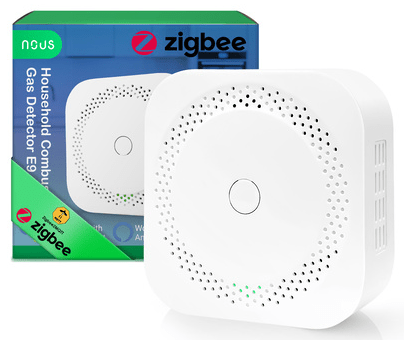
Once I got the garage wiring into some semblance of safety, the next job (another friend’s idea, I didn’t even think of it) was to firstly get one of my SwitchBot gas sensors out there (for visual instant feedback of poisonous gas) – the SwitchBot sensor is great as long as I have my phone with me (Bluetooth) except I don’t really trust the CO2 readings on the SwitchBot or the Sonoff similar units because none of the readings match) – and the SwitchBot unit needs a HUB to work on WiFi – secondly I have just fitted a non-display smart (Zigbee) E9 domestic gas sensor from Nous – that turned into an adventure – the long and short of it is – the E9 s a neat, white mains powered Zigbee sensor and ChatGPT and I developed a simple Home Assistant tile to show alarm status and an automation to contact both my wife’s phone and mine with a TTS audio alert (which doesn’t depend on the phone or the Home Assistant app being active) in the event of dangerously high gas levels.
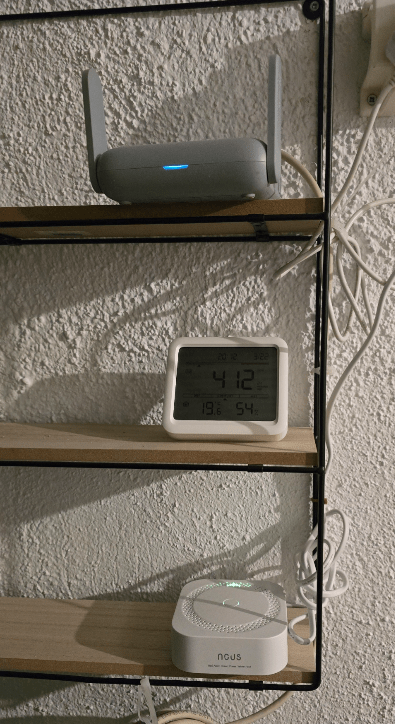
Here is the Home Assistant code below (the card-mod formatting is mine) – you’ll need HA Card-mod and the Mushroom cards for that..
type: custom:mushroom-legacy-template-card
entity: binary_sensor.nous_e9_gas_gas
primary: Gas Sensor
secondary: |
  {% if is_state(config.entity,'on') %}
    DANGER!!
  {% else %}
    SAFE
  {% endif %}
icon: mdi:gas-cylinder
icon_color: |
  {% if is_state(config.entity,'on') %}
    red
  {% else %}
    green
  {% endif %}
card_mod:
  style: |
    ha-card {
      border: 1px solid darkcyan;
      text-align: right;
      --card-primary-color: white;
      --card-secondary-color:
        {% if is_state(config.entity, 'on') %} #ff4444
        {% else %} #00ff88
        {% endif %};
      background:
        {% if is_state(config.entity, 'on') %}
          radial-gradient(circle, #7a0000 30%, #2a0000);
        {% else %}
          radial-gradient(circle, #003a1a 30%, #00150a);
        {% endif %};

      {% if is_state(config.entity, 'on') %}
      animation: gasalarm 1.5s infinite;
      {% endif %}
    }

    @keyframes gasalarm {
      0%   { transform: scale(1); }
      50%  { transform: scale(1.03); }
      100% { transform: scale(1); }
    }

    mushroom-state-info$:
      .secondary {
        text-align: right;
        width: 100%;
      }
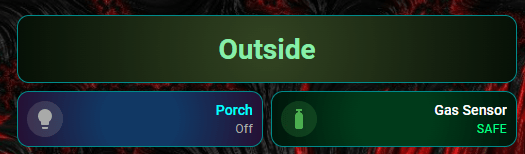
So that card and the below automation attach to the nous E9 gas detector via Zigbee….. clearly the action lines in the automation below will need to connect to one or more phones – in my case my wife and I have Samsung S24 phones and the Home Assistant companion apps – just different initials at the end. Here is the relevant image from my dashboard showing the green tile which turns bright red (with a simple animation – that was ChatGPT’s idea) if there is a gas alert.. below is the automation for an alert on our phones.
alias: Gas Detected TTS Loud
triggers:
  - entity_id: binary_sensor.nous_e9_gas_gas
    to: "on"
    trigger: state
actions:
  - action: notify.mobile_app_s24ultra_ps
    data:
      message: TTS
      data:
        ttl: 0
        priority: high
        media_stream: alarm_stream_max
        tts_text: >-
          Warning. Gas has been detected in the Spanish garage. Please
          investigate immediately.
  - action: notify.mobile_app_s24ultra_ms
    data:
      message: TTS
      data:
        ttl: 0
        priority: high
        media_stream: alarm_stream_max
        tts_text: >-
          Warning. Gas has been detected in the Spanish garage. Please
          investigate immediately.
mode: single
Next – the plan was a hole in the garage door for the exhaust (the manufacturer of the generator specifically state “no exhaust pipes” so that easy option is out) then it occurred to me to grab a cheap window exhaust fan and put that in the door near the exhaust from the generator, powered by the generator so that the fan extracts when the generator is on and the flaps close when it is off. There’s a vent above the garage door for incoming air which just needed some kind of mesh to stop half the world’s wasp population coming in.
Meanwhile as it is possible for the Lithium power unit to run out of power overnight (fridge etc) I decided my little UPS which runs the WiFi, a couple of routers and my Home Assistant mini-PC was in in need of an upgrade and spotted a UPS on Amazon that uses an external lead-acid battery rather than one of those tiny 7AH 12v jobs that you get in many UPS units.
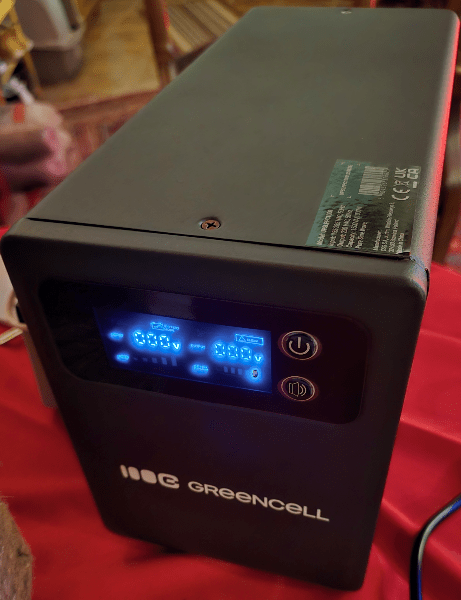
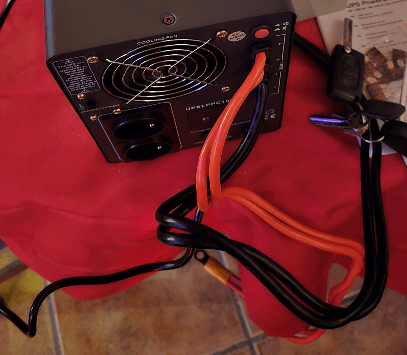
I think I may have gone overboard here judging by the weight of this thing – but here it is – a “Greenwall” unit from Amazon. Maximum 1KW (I don’t expect to need more than 50w if that so it should be good for nearly a day unless I need to include the fridge which can draw up to 250w).
Another learning curve – as one of my pals said you should never charge a lead-acid battery in a confined place – so it could be I need a lead through 3-layers thick of breezeblock to put the car battery in the (sheltered) porch.
Go on – ask why those leads below are so monstrous? They are the leads to the external battery not included with the UPS…. Really – this thing is HEAVY. As I was opening up I wondered if they’d sent me a model with built-in lead-acid battery – but no.
This is going to keep me busy for a day or two. Thankfully my smaller UPS is functioning OK for now.
See separate blog entry on the generators and lithium power unit mentioned above.